


















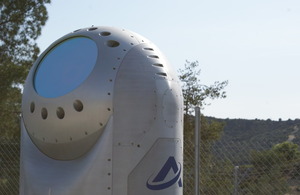
Ground station in Mediterranean downloads gigabits of data from passing satellite in just 90 seconds.
A demonstration of cutting-edge laser technology suggests that the UK’s armed forces will soon benefit from faster and more secure communications.
Working in partnership with the Defence Science and Technology Laboratory (Dstl), the Oxford-based Archangel Lightworks developed a deployable laser communications ground station. Tested at a location in the Mediterranean, this was able to download many gigabits of data during a 90-second pass by a satellite in low Earth orbit.
Compared to previously available technology, this is, says the government, ‘like moving from very slow internet to superfast fibre broadband.’
Laser communication – also known as ‘free space optical communications’ – enables high-speed transmissions over long distances, which is of course of great interest those working in intelligence, surveillance and reconnaissance. There are distinct operational advantages in being able to send large volumes of information quickly.
Laser communications use very low power, non-visible light instead of radio waves (that is, radio frequency or RF) to transmit data. Since light has a much shorter wavelength than radio waves, more data can be transmitted per second. This is also difficult to detect and intercept, significantly reducing the chance of detection by enemy sensors.
The narrow beams also reduce the chance of overlap with or interference from other networks and equipment. That means this technology would enable effective communicate in an increasingly congested electromagnetic environment.
Luke Pollard MP, Minister for Defence Readiness and Industry, says: ‘Space is crucial for how our armed forces communicate, allowing our sailors, soldiers and aviators to conduct the operations which keep the UK and our allies safe. By developing laser communications we’re dramatically increasing how quickly and securely our satellites can talk to our bases on Earth, protecting these communications from interference and giving us an advantage over our adversaries.’
Dr Paul Hollinshead, Chief Executive of Dstl, adds: ‘Laser communications will vastly improve the speed, size and security of data between our forces, whether they are in the air, on land, at sea or in space. This will greatly increase the security of our forces who will be able to convey critical information faster than their adversary. Our collaborative partnerships with industry catalyse innovation and enable Defence to be an engine for growth, supporting jobs and creating commercial opportunities.’
In related news:
Leave a Reply